
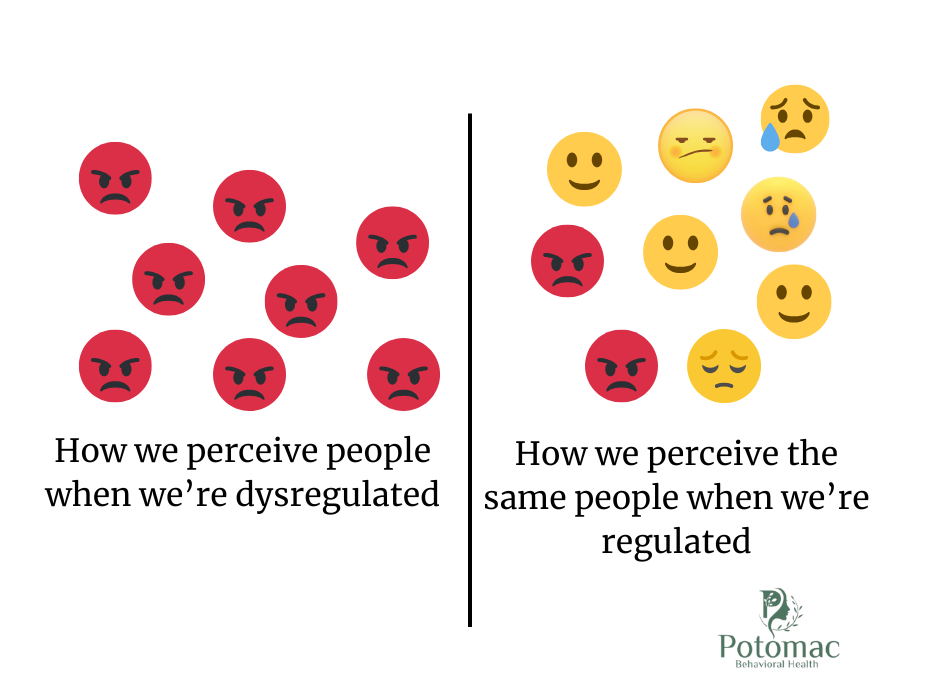
Have you ever had a stressful morning and suddenly everyone feels… irritating?
Or you walk into work and it seems like every expression is sharp, every comment is pointed, and every interaction feels harder than it should?
This isn’t because everyone around you suddenly changed. It’s because your nervous system did.
When we’re dysregulated (overwhelmed, anxious, exhausted, shut down) our brain shifts into a threat-driven mode. We become more sensitive, more reactive, and more likely to misread people and misinterpret neutral cues as negative.
In other words:
Your perception narrows to look for danger, even when danger isn’t there.
This isn’t “being too sensitive.” It’s a biological survival response, described in polyvagal theory, which explains how the nervous system changes perception under stress. But there’s good news! It’s something you can change.
How Dysregulation Makes Us Misread People
When your nervous system feels unsafe, your brain:
-
scans faces for signs of conflict
-
interprets neutral expressions as hostile
-
assumes negative intent
-
loses access to nuance and compassion
-
shifts into self-protective mode
Research shows that when the nervous system is under stress, the brain becomes more likely to misinterpret neutral cues as threatening. In one study, heightened fear states caused people to perceive ambiguous or neutral faces as fearful or angry, demonstrating how internal bodily states directly distort perception. Another study found that early, automatic processing biases under stress increase emotional reactivity, meaning the brain shifts attention toward possible threat even before you’re consciously aware of it.
Viewed through a trauma-informed lens, this isn’t a flaw. It’s a form of protection. Your body learned to scan for danger because, at some point in your life (or even generations before you), being hyper-aware of threat kept someone safe. These responses are ancient survival strategies. When they activate today, it’s your nervous system saying, “I’m trying to protect you the best way I know how.”
This is why, when you’re dysregulated, people can seem irritated, angry, or unsafe (even when they’re not). And it’s also why part of healing is learning to thank your body for how hard it has worked to keep you alive.
Why Your Brain Does This
The nervous system is built to prioritize survival over accuracy. When you’re dysregulated, the autonomic nervous system shifts into fight/flight/freeze mode.
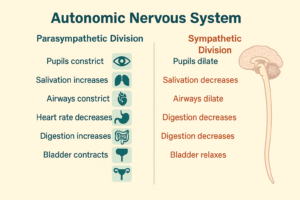
A visual overview of how the sympathetic and parasympathetic branches of the autonomic nervous system affect the body during stress and regulation.
This leads to:
-
heightened reactivity
-
misreading facial expressions
-
assuming negative intent
-
difficulty accessing empathy
Trauma research shows that people with a personal history of child maltreatment (especially sexual abuse) misinterpret facial expressions more frequently. This isn’t a personality flaw.
It’s a protective mechanism.
How Therapy Helps You Shift Out of Dysregulation
Potomac Behavioral Health uses trauma-informed, neuroscience-based approaches like EMDR, parts work, and the Safe & Sound Protocol to help your nervous system:
-
settle
-
reconnect
-
shift out of survival mode
-
move into safety and clarity
Many clients notice that, with regulation:
-
people no longer seem threatening
-
communication becomes easier
-
they stop assuming the worst
-
relationships feel softer and safer
It’s not the world changing. It’s your nervous system unpairing negative experiences and relearning safety.
A Simple Regulation Practice You Can Try Today
The 5-Second Drop-In
-
Exhale fully.
-
Drop your shoulders.
-
Notice one sensation in your body.
-
Name what you’re feeling (“tight,” “foggy,” “flat”).
-
Remind yourself: “My body is trying to protect me.”
This brief pause reduces sympathetic arousal and expands perception, consistent with polyvagal-informed practices.
If you want support shifting out of dysregulation
Potomac Behavioral Health specializes in trauma-informed therapy that helps adults move from survival mode into regulation quickly, gently, and with a deep understanding of how the nervous system shapes perception, relationships, and emotional stability.
If you’re ready to see yourself and others more clearly, book a free 15 minute consultation to see how Potomac Behavioral Health can help you shift from an aroused survival state to a grounded secure state.