

The holidays are often described as a time of closeness, connection, and togetherness.
But for many people, this season brings a noticeable spike in anxiety, especially in relationships.
If you find yourself overanalyzing texts, worrying about how others perceive you, or feeling unsettled by distance or changes in routine, you may be experiencing anxious attachment patterns.
(And no, you’re not “too sensitive.) Your nervous system is responding to very real cues.
Why anxious attachment intensifies during the holidays
Anxious attachment is not a personality flaw. It is a nervous system pattern that often develops when connection has felt inconsistent, unpredictable, or emotionally unsafe earlier in life.
The holidays tend to amplify this pattern for several reasons:
Disrupted routines
Time off work, travel, and altered schedules remove the predictability your nervous system relies on to feel safe.
Increased relational exposure
Extended time with family, partners, or in-laws can heighten sensitivity to tone, body language, and perceived rejection.
Heightened expectations
There is often unspoken pressure for the holidays to feel meaningful or emotionally fulfilling, which raises the stakes for connection.
Separation and distance
Travel, delayed responses, or changes in availability can activate fears of abandonment or disconnection, even in otherwise stable relationships.
When these factors combine, the nervous system may move into hypervigilance, constantly scanning for signs that connection is at risk.
This often overlaps with holiday stress and nervous system dysregulation, which can make emotional reactions feel more intense and harder to regulate.
When anxious attachment began with a parent
For many adults, anxious attachment did not originate in romantic relationships. It began in early relationships with a parent or caregiver.
If emotional availability was inconsistent, unpredictable, or conditional growing up, your nervous system may have learned that closeness requires vigilance. Even years later, being around a parent can reactivate that same attachment alarm.
The holidays often intensify this because they place adult children back into familiar roles:
-
Staying in childhood homes
-
Reverting to old family dynamics
-
Being exposed to subtle criticism, dismissal, or emotional unpredictability
-
Feeling pressure to “keep the peace” or meet unspoken expectations
When the parent was the original source of attachment insecurity, holiday gatherings can feel like a minefield of nervous system triggers, even if the relationship appears “fine” on the surface.
Your body remembers what your mind may try to minimize.
Common signs of anxious attachment during the holidays
You might notice:
-
Worrying about how others perceive you
-
Feeling responsible for everyone else’s mood
-
Reading into silence, tone, or delayed responses
-
Seeking reassurance but still feeling unsettled
-
Feeling especially sensitive to rejection or emotional distance
For adult children, this may also show up as:
-
Feeling unusually young, small, or emotionally reactive around parents
-
Hyper-monitoring a parent’s mood or approval
-
Feeling guilt for having needs, limits, or separate opinions
-
Struggling to set boundaries without anxiety or self-doubt
-
Feeling dysregulated long after a family visit ends
These responses are not signs of immaturity. They are signs of a nervous system responding to long-standing relational patterns.
Why logic and reassurance aren’t enough
Many people try to manage anxious attachment with reasoning:
“I know I’m overreacting.”
“They didn’t mean it.”
“I shouldn’t feel this way.”
While insight can be helpful, anxious attachment lives primarily in the body.
When the nervous system perceives a threat to connection, it activates a nervous system stress response that logic alone cannot turn off.
This is why reassurance often brings only temporary relief.
A subtle boundary-setting example (what this can look like in real life)
Boundary setting with anxious attachment (especially with parents) often fails when it’s treated as a confrontation.
In practice, boundaries are more about regulating yourself than changing the other person.
For example:
“I’m going to take a short walk after dinner to reset. I’ll be back in a bit.”
This is not an explanation or a defense.
It’s a nervous-system-supportive choice that reduces overwhelm without escalating conflict.
Small, quiet boundaries like this help your system learn that you can stay connected without abandoning yourself.
What actually helps: a trauma-informed approach
Trauma-informed therapy focuses on helping the nervous system experience felt safety, not just intellectual understanding.
This work may include:
-
Learning grounding and regulation tools to calm attachment activation in real time
-
Identifying attachment triggers without self-judgment
-
Reprocessing earlier relational experiences that taught your system to stay on high alert
-
Practicing boundaries and communication from a regulated state rather than survival mode
Approaches such as trauma-informed therapy like EMDR help the nervous system update old patterns so closeness no longer feels fragile or easily lost.
Staying in your circle of control during the holidays
One of the most effective ways to reduce attachment anxiety is shifting attention back to focusing on what’s actually within your control.
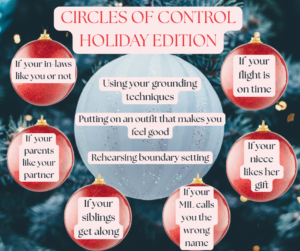
You cannot control other people’s reactions, moods, or availability, but you can support your own nervous system so those external factors feel less overwhelming.
This is where regulation skills and boundary rehearsal become especially valuable during the holiday season.
Support during the holiday season in Maryland and Virginia
If anxious attachment tends to intensify for you during the holidays, you don’t have to push through it on your own.
Potomac Behavioral Health offers trauma-informed, therapy for adults in Maryland and Virginia, with a focus on:
-
Attachment healing
-
EMDR and bottom-up approaches
A few appointment spots are available before the holidays.
If support right now would be helpful, you’re welcome to reach out.